NSFW AI and uncensored AI, explained

Both terms describe a content filter that has been loosened. Neither says which filter, and there are four of them — which is why two services that use the same word behave nothing alike.

Where the filter actually sits

The training

Refusal is learned, not configured.

A language model is fine-tuned on examples of what to answer and what to decline. After that, declining is part of the weights themselves, in the same way that grammar is. Nothing is looking up a rule at the moment you hit send.

Changing this layer means retraining the model, or running one that was trained differently — which is what open-weight models make possible, and why a service running its own model can differ from one renting an API. It is also why a service can call itself uncensored and still refuse things: no setting reaches this far down.

The system prompt

Standing instructions you never see.

Before your first message, the provider puts its own instructions in front of the conversation: who the character is, what it should never discuss, how it should answer when it does refuse.

This is the cheapest layer to loosen — it is text, not training — and the only one a service can change without touching the model at all. It is also the least reliable, because it competes with the training underneath it. When a service behaves differently from one day to the next, this is the layer that can move that fast.

A separate classifier

A second model reading over the first one’s shoulder.

Many services run a smaller, separate model that reads your message, the reply, or both, and scores it. Above a threshold, the message is blocked, softened or replaced with a canned line.

Because it sits outside the chat model, it can stop output the chat model was perfectly willing to produce. That is the difference you feel when a conversation cuts off mid-sentence rather than the character declining in its own words.

Review after the fact

Nothing is blocked; something is recorded.

The last layer does not stop a message at all. Conversations may be logged, sampled, reported by other users, or reviewed by staff, and the consequence arrives later: a warning, a suspension, a closed account.

This is the layer people most often forget, and the only one where what happens to the text matters more than what the model said. It is also the one worth asking about before you type anything you would not want kept.


So what does “uncensored” buy you

Layers two and three are the ones a service can loosen by decision alone: a permissive system prompt, and no classifier standing over the reply. Layer one costs a training run, so unless a service runs its own model, that is the layer the word leaves untouched.

That gap explains most of the disappointment. A service can be entirely honest about removing its filter and still produce a model that declines, hedges or steers away, because the part doing that was never the filter. The word describes a policy, not a capability.

What to check before you trust one

These questions have answers on any service worth using, and the answers are usually in the terms rather than on the landing page.

Is your age verified, or only asked?
A checkbox is not verification. Some services check a document or a card; most ask and move on. Neither is wrong, but they are not the same promise, and only one of them says anything about who else is in there.
Are conversations kept, and for how long?
Look for a retention period in plain words. "We may retain data as necessary" is not a period. If deletion is offered, check whether it removes the conversation or only your account.
Who can read them?
Encryption at rest protects against a stolen disk, not against the provider. If moderation happens after the fact, someone can read what was written. That is not sinister, but it should be stated.
Whose law applies?
The company’s country decides what it must hand over and what rights you have to your own data. It is usually in the terms, near the bottom, in one sentence.
How does it appear on a statement?
Paid adult services often bill under a neutral descriptor. Whether that matters is your call, but it is easier to find out before the first charge than after.

Where MaiFriends stands

MaiFriends is not an uncensored service, and it would be strange to claim otherwise on this page. It ships through Google Play, Play does not allow sexual content, and the app works inside those rules. If a filter with nothing in front of it is what you came for, this is not that.

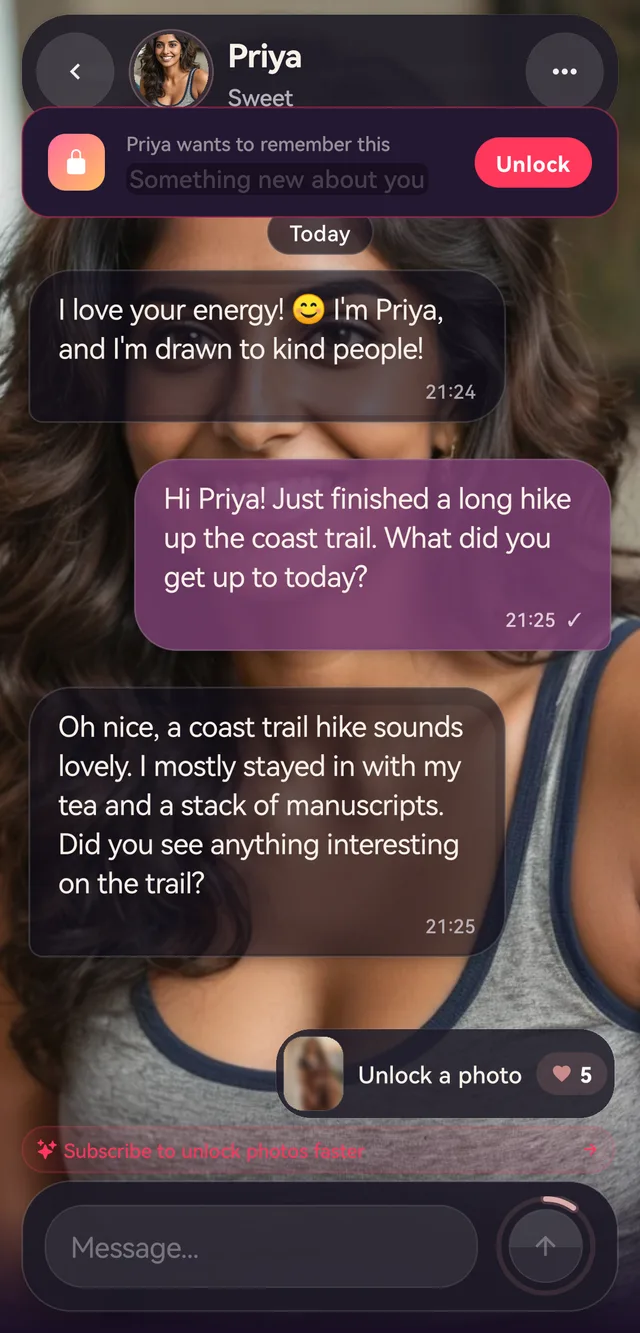
What it is: an Android app rated 18+, which says so on its own listing, built around characters with a backstory, a nationality, a job and a way of talking. The draw is meant to be the conversation and the company, not what the filter permits. There is no web chat, so there is nothing to try in this tab.

See the app on Google Play →
A conversation in the MaiFriends app: Priya opens with a line about herself and answers a message about a coast trail hike